Table of Contents
Introduction: Semrush Sensor
If you work in SEO, you know the feeling of panic that comes with a sudden, unexplained drop in traffic. Is it a technical error? A competitor’s big move? Or another Google algorithm update? The Semrush Sensor is the tool designed to answer that critical question. It acts as a weather radar for Google’s search results, tracking daily volatility to help you distinguish between a site-specific issue and a widespread industry shake-up. In this guide, we’ll explore how you can use the Semrush Sensor to diagnose ranking changes accurately and turn uncertainty into a clear, actionable strategy.
What is the Semrush Sensor and Why Should You Care?
Have you ever experienced that sinking feeling when you check your analytics and see a sudden, unexplained drop in website traffic? The immediate panic is real, followed by a frantic search for answers. Was it a technical glitch on your site? Did a competitor just leapfrog you? Or is this the result of a mysterious Google algorithm update?
This uncertainty is precisely where the Semrush Sensor becomes an indispensable tool. Think of it as a weather radar for Google’s search results. The Semrush Sensor is a free tool that tracks daily fluctuations, or volatility, in Google’s search engine results pages (SERPs). It monitors millions of keywords across dozens of industries to detect when significant changes are happening.
So, why should you care? Because the Semrush Sensor helps you answer the most critical question when your rankings change: “Is it me, or is it Google?” By monitoring SERP volatility, you can quickly determine if a shift in your website’s performance is due to a site-specific issue you need to address or a widespread algorithm update affecting your entire industry. This insight is crucial for making informed, strategic decisions instead of panicked, reactive ones.
How the Semrush Sensor Works
At its core, the Semrush Sensor operates as a sophisticated data analysis engine. It doesn’t guess or speculate about algorithm changes; it measures their effects by tracking real-time movements in Google’s search results. The process can be broken down into a few key steps.
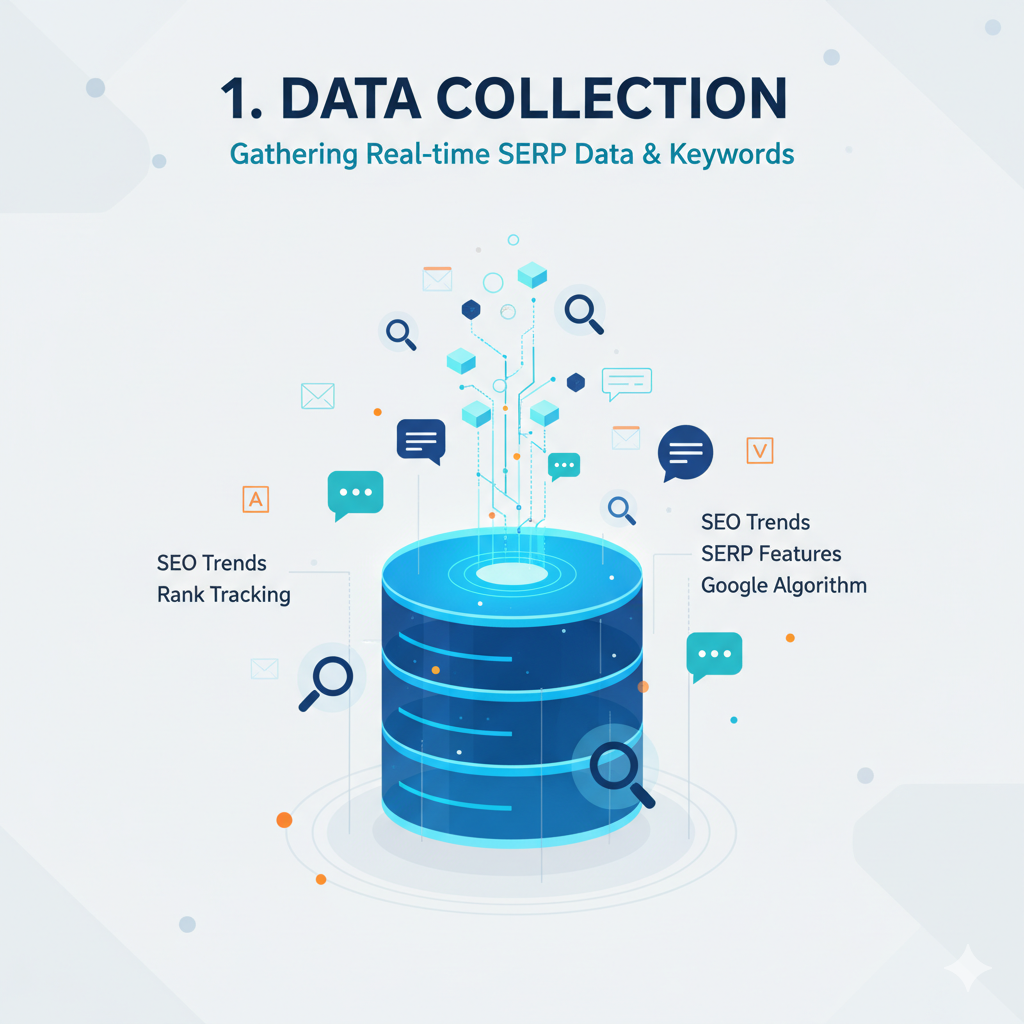
First, the tool collects massive amounts of data by monitoring a fixed set of millions of keywords across more than 20 different industries. It scans the search engine results pages (SERPs) for these keywords daily.
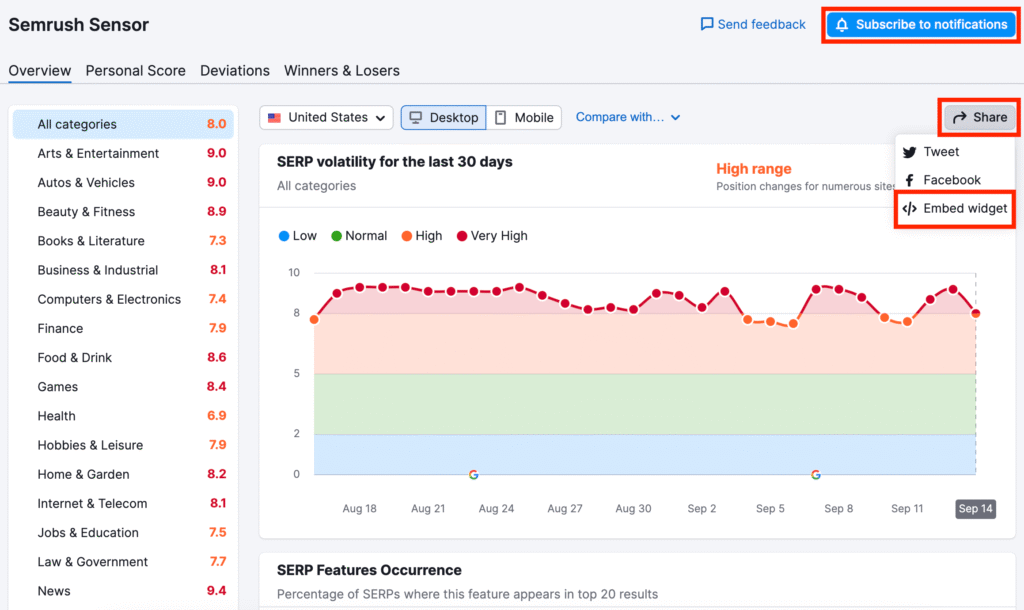
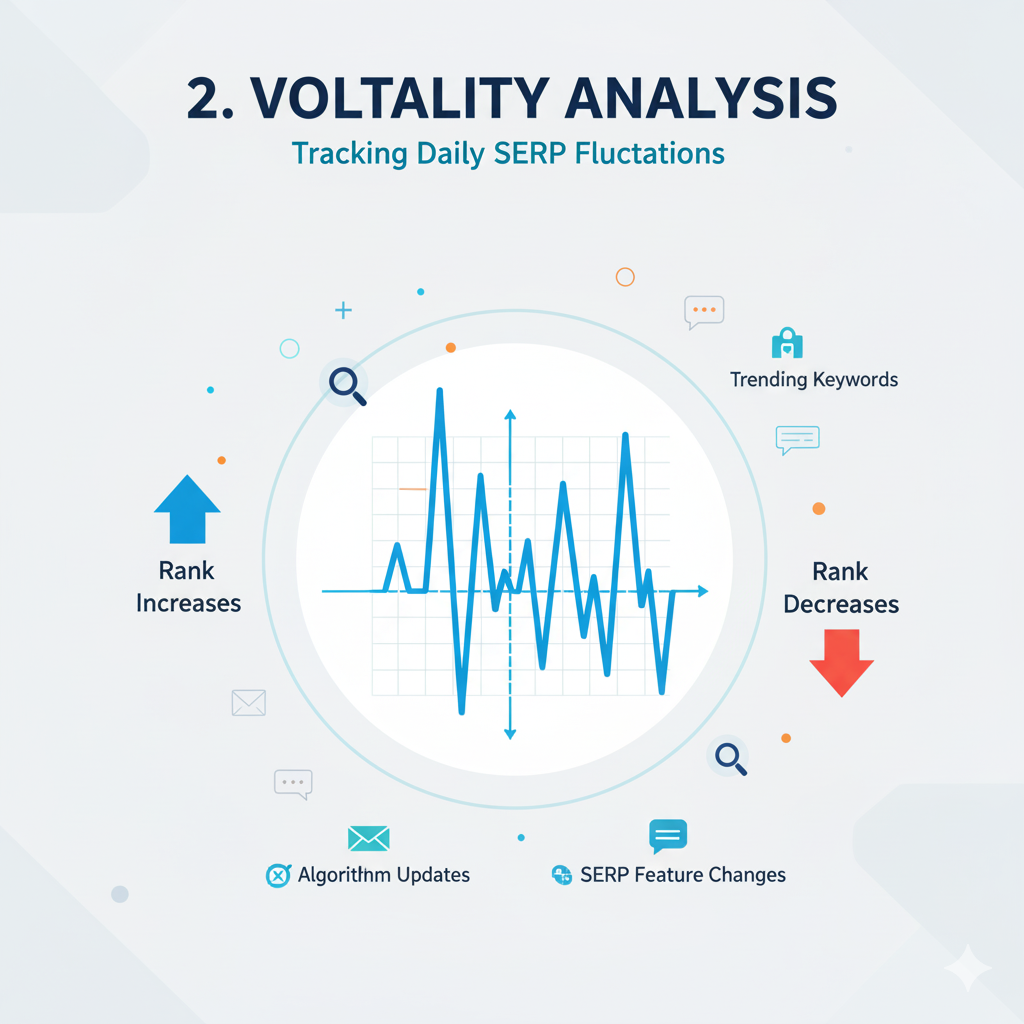
Next, it compares the rankings from one day to the next. The Semrush Sensor meticulously analyzes how much the top-ranking pages have moved up or down. A day with very little movement means the SERPs are stable, while a day with widespread, significant ranking changes indicates high volatility.
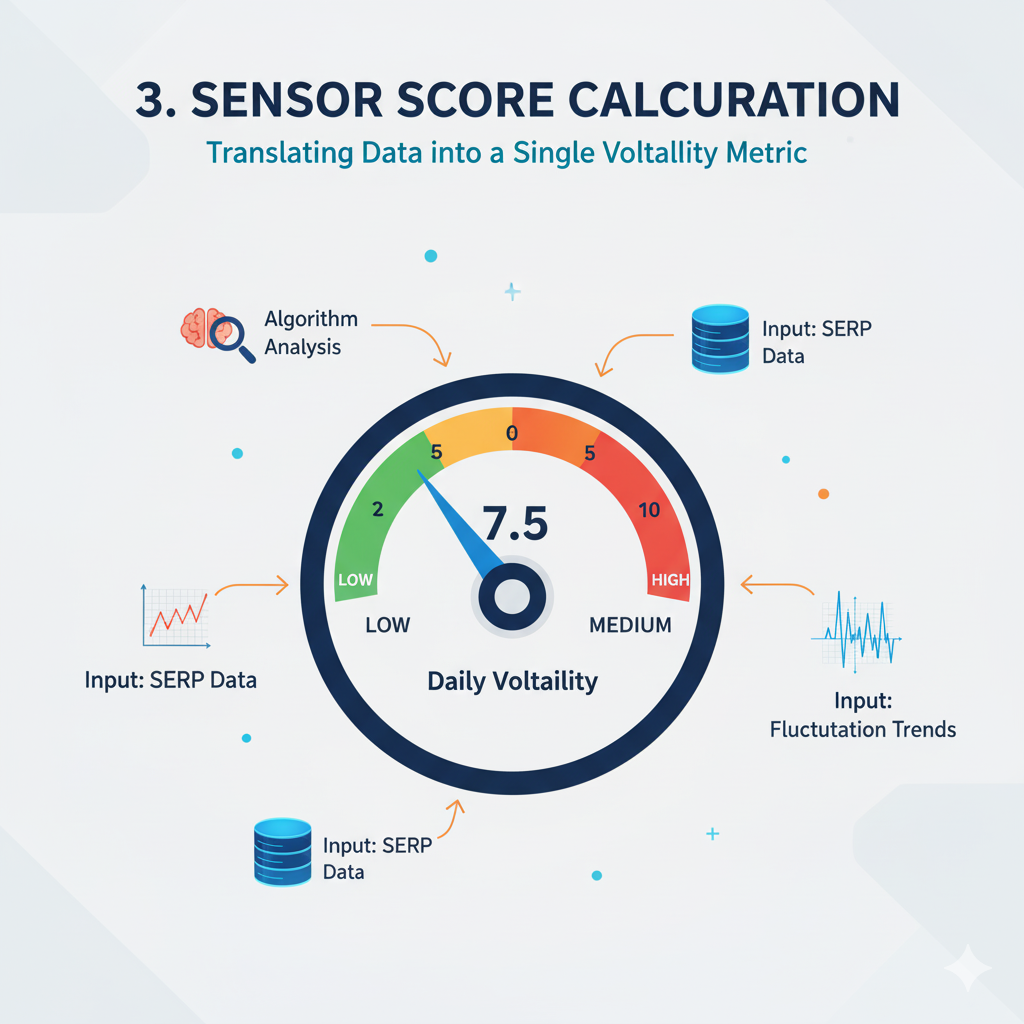
Finally, all of this data is compiled to calculate a single, easy-to-understand “Sensor score.” This score quantifies the overall volatility for the day on a simple 0-to-10 scale, providing a clear snapshot of how turbulent the search landscape is. This daily score, which is updated throughout the day, helps you quickly gauge the level of change and determine if a major event, like a Google update, is underway.
Decoding the Semrush Sensor Score (0-10)
The main output of the Semrush Sensor is its daily volatility score, which simplifies all the complex data into a single number from 0 to 10. This score tells you, at a glance, just how much turbulence is happening in Google’s search results on any given day.
Here’s a simple breakdown of what the numbers mean :
- 0–2 (Low): A calm day. Search rankings are stable with minimal fluctuation.
- 2–5 (Normal): Business as usual. This represents the typical, everyday background noise and minor shifts in the SERPs.
- 5–8 (High): Significant movement. This score suggests that rankings are changing more than usual, often signaling a smaller Google update or major industry-specific shifts.
- 8–10 (Very High): Major shake-up. A score this high is a strong indicator of a significant Google algorithm update that is causing widespread ranking changes across the web.
It’s important to remember that a high score isn’t inherently good or bad. It simply means rankings are in flux. On a high-volatility day, your site could just as easily gain positions as it could lose them. The key is that the Semrush Sensor score alerts you that it’s time to pay closer attention and investigate what’s happening.
Key Feature: Industry-Specific Volatility Tracking
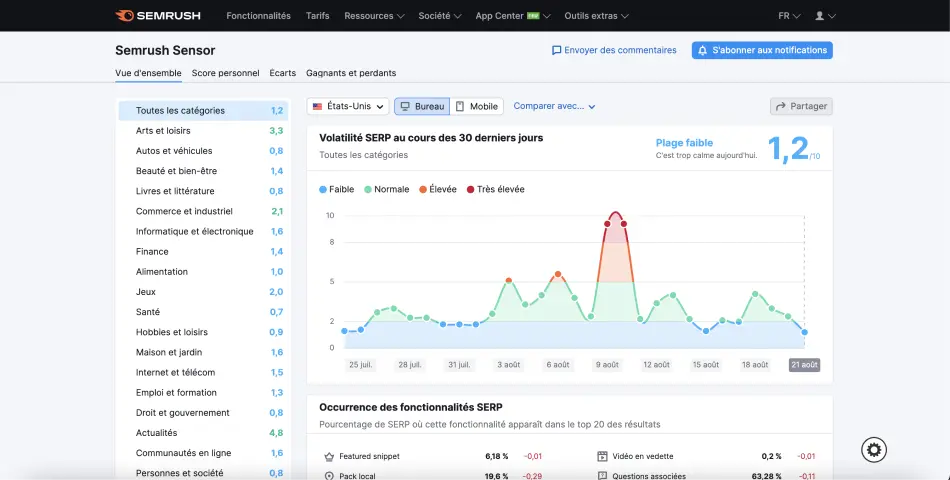
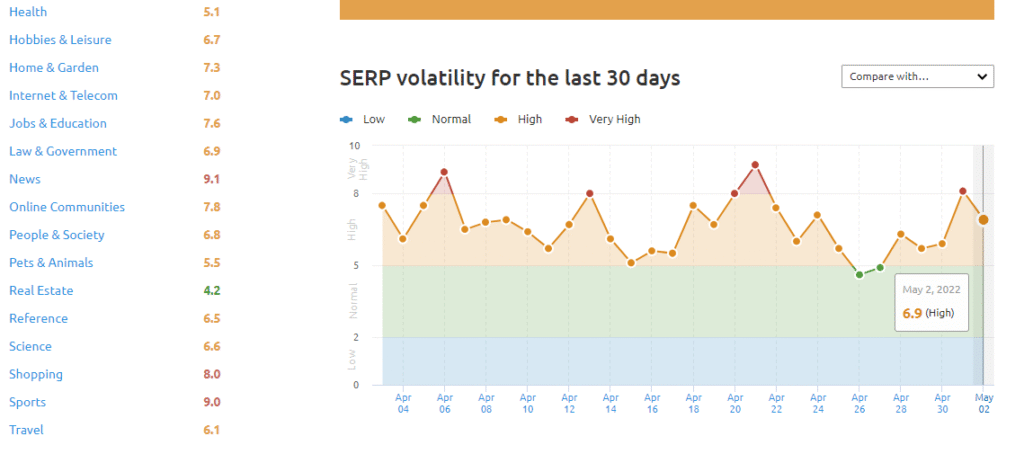
One of the most powerful features of the Semrush Sensor is its ability to go beyond a single, universal score. Not all Google algorithm updates affect every website equally; some are laser-focused on specific niches. This is why industry-specific volatility tracking is so valuable.
The Semrush Sensor breaks down its data into more than 20 distinct categories, including “Health,” “Finance,” “Shopping,” “Real Estate,” and “Travel”. This means you can filter out the noise and see the volatility score that is directly relevant to your market.
For example, a Google update focused on product reviews might cause a massive spike in volatility for the “Shopping” category while having little to no impact on the “Law & Government” category. By focusing on your specific industry, you can accurately determine if a change in your rankings is part of a niche-wide trend. This allows you to analyze what successful competitors are doing in response and adjust your strategy with much greater precision.
Key Feature: Device and Location-Specific Insights
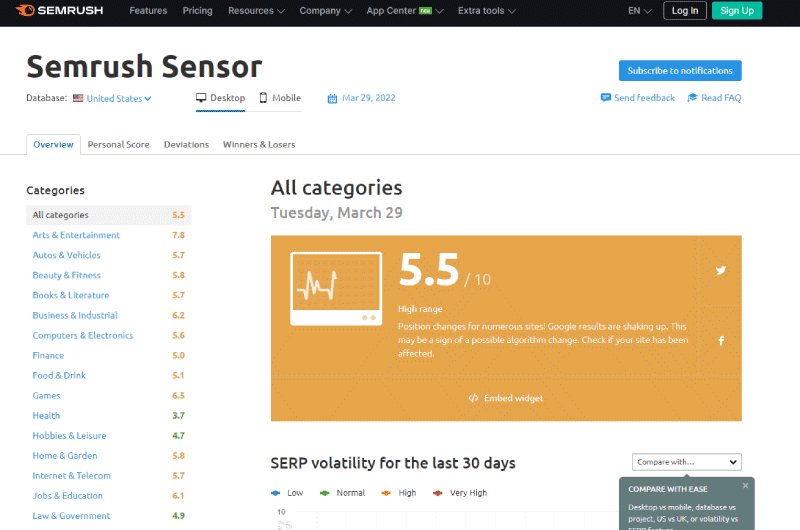
In today’s global and mobile-first world, a single, universal view of search results is no longer sufficient. The Semrush Sensor recognizes this by providing crucial insights specific to different devices and geographic locations. This allows you to tailor your analysis to the exact audiences you are trying to reach.
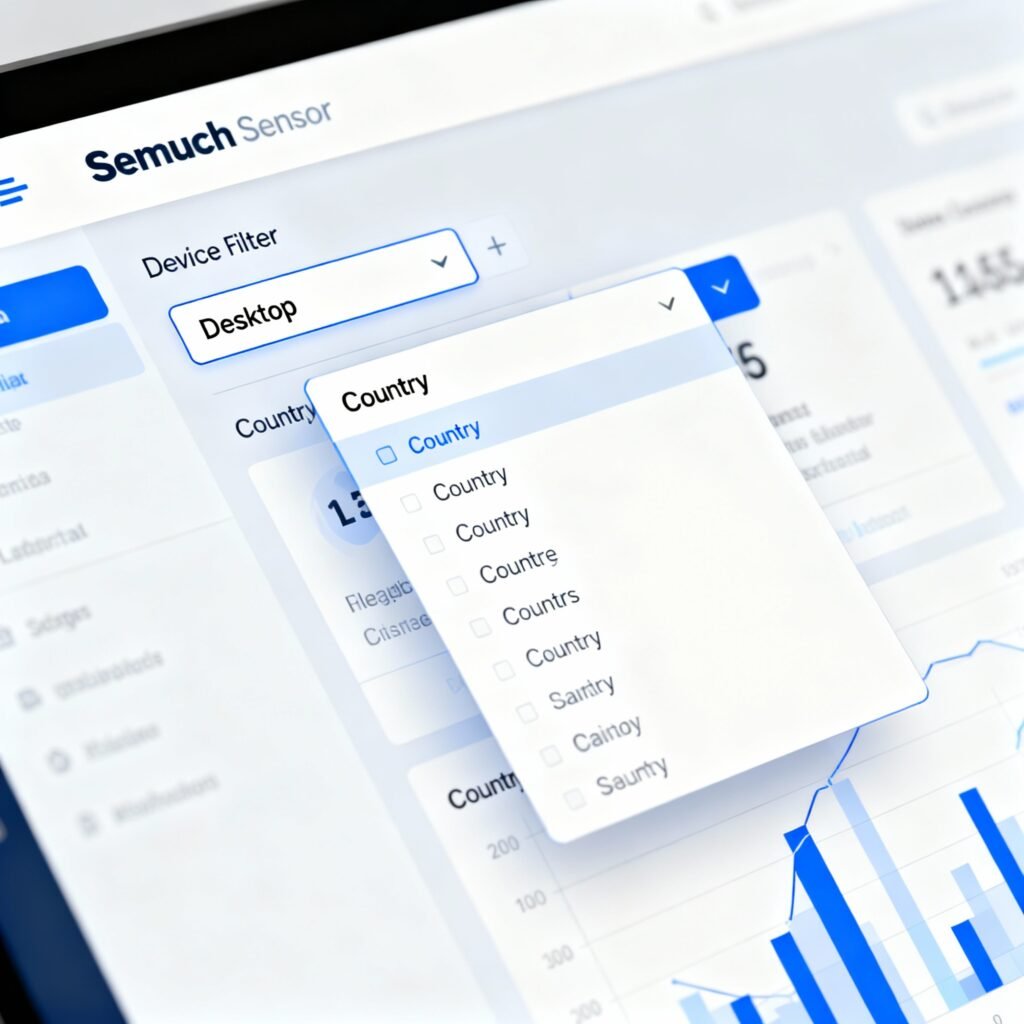
With the Semrush Sensor, you can easily toggle between desktop and mobile volatility scores. This is incredibly important because Google often rolls out changes that affect mobile and desktop results differently. If you notice a drop in mobile traffic, you can check the mobile-specific score to see if it’s part of a broader mobile SERP shake-up.
Furthermore, the tool allows you to filter volatility data by country. You can track SERP fluctuations in major markets like the United States, the UK, Australia, Germany, and more. This is essential for international SEO, as an algorithm update might be deployed in one country but not another. By narrowing your focus, you can make more precise decisions for your local and global SEO campaigns.
Key Feature: Personal Score for Custom Keyword Sets
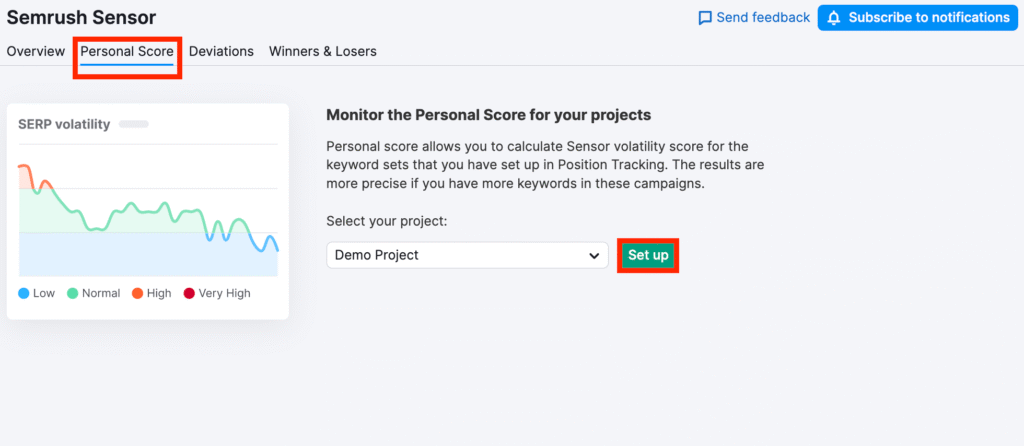
While industry-level data is incredibly useful for seeing the big picture, what often matters most is how SERP volatility affects the specific keywords you are actively targeting. This is where the Personal Score feature of the Semrush Sensor provides a more granular and powerful view.
The Semrush Sensor integrates directly with Semrush’s Position Tracking tool, allowing it to calculate a unique “Personal Score”. Instead of relying on the broad, predefined keyword set that the tool uses for industry analysis, this feature calculates a volatility score based exclusively on the custom list of keywords you are tracking for your own projects.
This provides a highly precise and personalized report. For example, the overall score for the “Finance” industry might be low, but if your Personal Score is high, it tells you that the specific long-tail keywords you’re targeting are experiencing significant fluctuation. This focused insight helps you filter out irrelevant market noise and pinpoint changes that directly impact your SEO efforts, enabling a much faster and more accurate diagnosis of ranking shifts.
Using the Sensor to Analyze Google Algorithm Updates
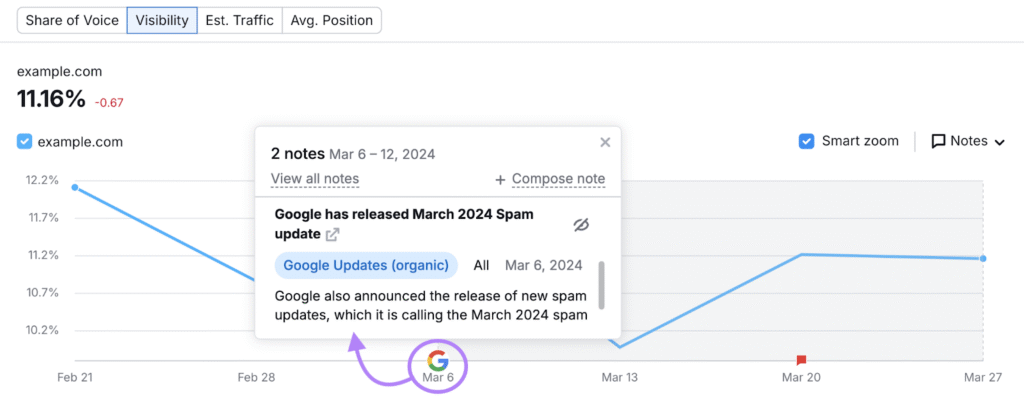
One of the most critical functions of the Semrush Sensor is to serve as an early-warning system for Google algorithm updates. When Google implements a significant change, it often causes widespread turbulence in the search results. The Sensor is specifically designed to detect this activity, giving you the first clue that something major is happening.
A score that suddenly jumps into the “High” (5-8) or especially the “Very High” (8-10) range is a strong signal that a Google update is likely rolling out. To make this even clearer, the Semrush Sensor often displays annotations directly on its volatility graph to mark confirmed Google updates. This allows you to immediately correlate a day of high volatility with a specific, named event like a “Core Update” or “Helpful Content Update.”
Beyond simply alerting you, the tool helps you analyze the nature of the update. By checking which industries and SERP features are most affected, you can start to understand what the algorithm change is targeting. This insight is crucial. Instead of just knowing an update happened, you can begin to deduce its purpose, allowing you to diagnose ranking changes accurately and adjust your SEO strategy with confidence rather than guesswork.
The “Winners and Losers” Feature
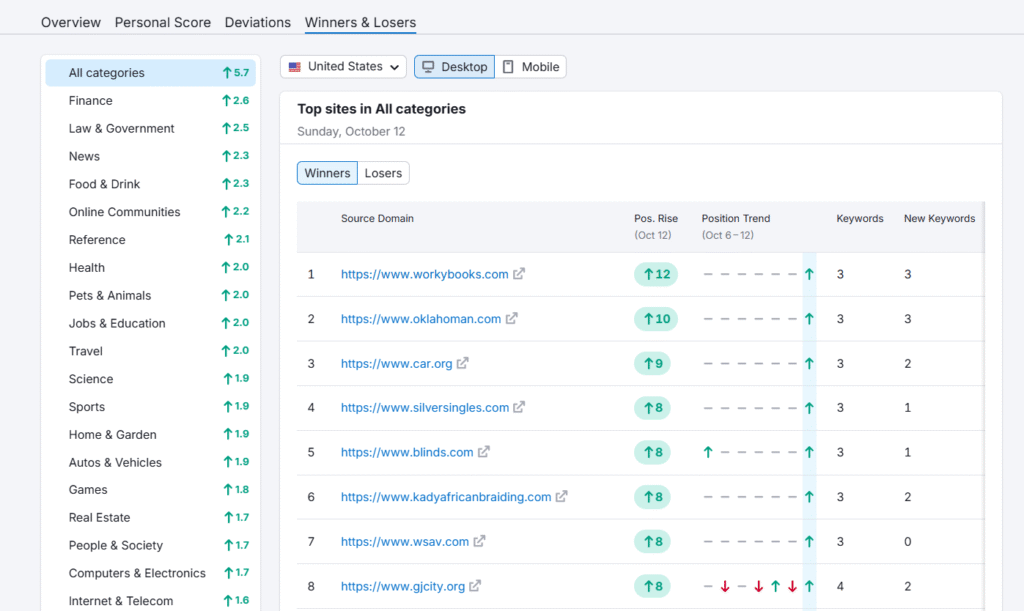
Knowing that volatility is high is one thing, but knowing who is benefiting from it—and who isn’t—is where you can find truly actionable insights. The Semrush Sensor provides this information through its “Winners and Losers” feature.
This section of the tool shows you exactly which domains have experienced the biggest gains or losses in rankings on any given day, particularly during periods of high volatility. The Semrush Sensor calculates the average movement of URLs within the top 20 search results for each domain it tracks and presents you with a clear list of the most affected websites.
This feature is a goldmine for competitive analysis, especially after a Google update. By analyzing the “Winners,” you can investigate their websites to see what types of content or SEO strategies are being rewarded by the algorithm change. Conversely, studying the “Losers” can help you identify tactics that are now being penalized or devalued, allowing you to avoid making the same mistakes. It provides a real-world look at what’s working right now, enabling you to adapt your strategy based on current data, not just theory.
Practical Application: Diagnosing a Drop in Rankings
When you notice a drop in your rankings, your first instinct might be to panic and start making changes. However, the first step should always be to diagnose the problem correctly. This is the most practical and valuable application of the Semrush Sensor.
Here is a simple, two-step process to follow:
- Check the Semrush Sensor Score: Before you touch a single line of code or edit any content, open the Semrush Sensor. Look at the overall volatility score for the day your rankings dropped. Is it high (above 5) or very high (above 8)?
- Interpret the Score:
- If the score is high: The ranking drop is likely due to a widespread Google algorithm update, not something you did. In this case, the best course of action is often to wait. Don’t make drastic changes immediately. Instead, use the Sensor’s other features to analyze which competitors are winning and what type of content is being rewarded, and plan your adjustments calmly.
- If the score is low: A low score means the search results are stable. Therefore, if your site’s rankings have dropped, the issue is almost certainly specific to your website. This is your cue to begin an internal audit. Check for manual actions in Google Search Console, review any recent site changes, analyze your backlink profile, and conduct a technical SEO health check.
By following this simple diagnostic process, the Semrush Sensor helps you avoid wasting time fixing problems that don’t exist and allows you to focus your energy where it’s truly needed.
Staying Informed with Sensor Notifications
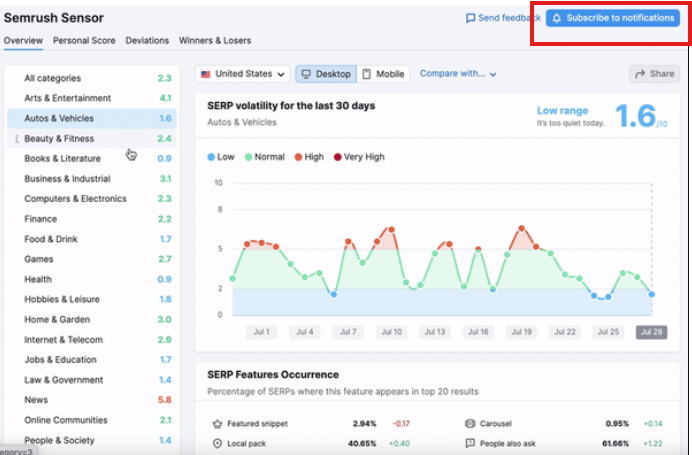
To ensure you never miss a critical event, the Semrush Sensor includes a notification system that brings the most important updates directly to you. Instead of having to manually check the dashboard every day, you can stay informed automatically, allowing you to remain proactive rather than reactive.
You can easily subscribe to receive alerts via email or as browser push notifications. The system is designed to be intelligent and avoid alert fatigue. A notification is triggered only when the volatility score makes a significant jump—for example, from the “Normal” zone to the “High” or “Very High” zone. If volatility remains high for several consecutive days, you will only receive an alert for the initial jump.
This feature acts as an immediate heads-up that a potential Google algorithm update or a major market shift is likely underway. By getting this timely alert, the Semrush Sensor empowers you to investigate and respond to changes as they happen, ensuring you’re always one step ahead.
Conclusion: Integrating the Semrush Sensor into Your SEO Workflow
In the ever-changing landscape of search engine optimization, staying informed is not just an advantage—it’s a necessity. The Semrush Sensor is more than just another metric to watch; it’s a fundamental tool that empowers you to navigate Google’s frequent algorithm updates with clarity and confidence.
By making the Semrush Sensor a regular part of your SEO workflow, you transform your strategy from reactive to proactive. Instead of panicking when rankings shift, you can calmly diagnose the cause, analyze what’s working for your competitors, and make intelligent, data-driven decisions. Whether you’re investigating a traffic drop, monitoring for algorithm updates, or looking for competitive insights, the Sensor provides the context you need to act effectively.
Ultimately, integrating this tool into your daily or weekly checks will save you time, reduce uncertainty, and help you build a more resilient and successful SEO strategy in the long run.